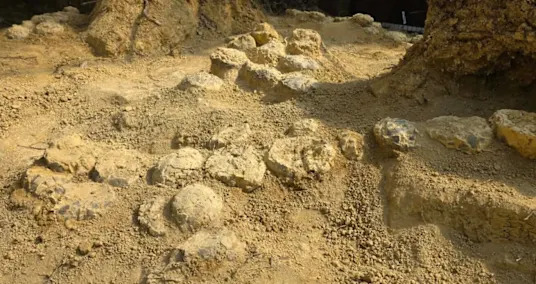
Imagine brushing away 72 million years of sediment and uncovering hundreds of dinosaur eggs, their shells still intact after surviving everything from asteroid impacts to ice ages. That’s exactly what happened at the Mèze fossil site in southern France, where paleontologists working through the winter months revealed one of the world’s most significant dinosaur nesting grounds. The discovery feels like stumbling upon a prehistoric treasure trove—if ancient titanosaurs had curated their own museum exhibits.
Ancient Nursery Preserved in Stone
Museum director calls the find an unprecedented gathering of fossilized eggs.
Alain Cabot, director-curator of the Musée-Parc des Dinosaures de Mèze, described the discovery as an “exceptional concentration” spanning 15 square miles of Upper Cretaceous rock. Over 100 eggs became visible within weeks of careful excavation, with many retaining their internal structures—a paleontologist’s equivalent of finding unopened time capsules. The fossil-rich layer extends far beyond the current dig site, suggesting this ancient maternity ward holds many more secrets waiting 70-72 million years for their moment in the spotlight.
A Snapshot of Cretaceous Family Life
Titanosaurs dominated the nesting ground, but smaller dinosaurs also called it home.
The eggs primarily belong to titanosaurs—those massive long-necked herbivores that would dwarf modern elephants. Yet scattered among these giants are smaller treasures:
Eggs from ankylosaurs
Tiny theropods, including the rare Prismatoolithus caboti, one of the smallest carnivorous dinosaur eggs ever discovered
Picture a Cretaceous suburbia where different species chose the same prime real estate for raising their young, much like how modern birds flock to protected wetlands during nesting season.
Modern Wonder Meets Ancient Mystery
Social media buzz reflects enduring fascination with dinosaur discoveries.
The museum’s Facebook announcement exploded with over 1,500 reactions and hundreds of shares, proving dinosaurs still captivate imaginations across generations. Visitors can now observe the ongoing excavation in person, watching scientists methodically reveal creatures that nested here when flowering plants were still evolutionary newcomers. The preserved floodplain environment—where periodic flooding rapidly buried eggs under protective sediment—created perfect fossilization conditions that geological time couldn’t destroy.
Each egg represents a moment frozen in deep time, waiting 72 million years for someone to rediscover the story of these ancient parents and their hopes for the next generation.
From the coolest cars to the must-have gadgets, GadgetReview’s daily newsletter keeps you in the know. Subscribe - it’s fun, fast, and free.
LATEST POSTS
- 1
 US FDA grants market authorization to six on! PLUS nicotine pouch products
 - 2Best Pizza Beating: What's Your #1?
- 3CMA Awards 2025: Full list of nominations, from Entertainer of the Year to Album of the Year
- 4From Fledgling to Master: Self-awareness in a Side interest
- 5Reports: Nepal's former PM arrested over deadly protest crackdown



- ‘Harry Potter and the Philosopher’s Stone’ trailer is raising eyebrows among Potterheads: ‘Where’s the whimsical color?’
- Surveys of Music Collections by Film Stars
- Claim that Israel opened 'sewage dam' into Gaza's main river undersells sanitation crisis
- The most effective method to Consummate the Specialty of Handshaking in Business and Group environments
- Exploring Being a parent: A Survey of \Bits of knowledge and Guidance for Guardians\ Nurturing Book
- Instructions to Expand Your Advantages from an Open Record Reward
- Surprise! Saturn's huge moon Titan may not have a buried ocean after all
- Flourishing in a Cutthroat Work Market: Vocation Methodologies
- More than 800 flights canceled as FAA cuts traffic at 40 major airports. Here's what to know.