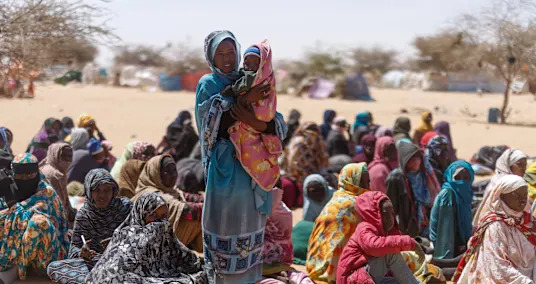
Hanaan was 18 years old when she was raped by members of the Rapid Support Forces (RSF), a paramilitary group accused of committing widespread “war crimes” during nearly three years of fighting against Sudan’s army.
She was walking alongside a female friend to her makeshift home in an encampment for displaced people in South Darfur, when four men on motorbikes stopped them and asked where they were going.
“Two took each girl, and they raped us,” she told Doctors Without Borders, an international medical NGO known by its French initials MSF.
“I feel uncomfortable in my body, heavy. I don’t feel pain, apart from in my back – because they beat me, they beat me with their guns on my back,” she said.
Hanaan – not her real name – shared her testimony as part of a report released by MSF on Tuesday, which details the widespread use of sexual violence as a weapon in Sudan’s ongoing brutal civil war.
The NGO said 3,396 survivors of sexual violence sought treatment in MSF-supported health facilities across North and South Darfur between January 2024 and November 2025.
The data, presented in the report titled, There is Something I Want to Tell You…, was drawn from MSF programmes in just two of Sudan’s 18 states and reflects only a fraction of the crisis, while the true scale of the phenomenon remains unknown.
Women and girls accounted for 97 percent of survivors treated in MSF programmes. The RSF and allied militias were found to be primarily responsible for the systematic abuse.
Children among the survivors
“Sexual violence is a defining feature of this conflict – not confined to front lines, but pervasive across communities,” Ruth Kauffman, MSF emergency health manager, said in a statement.
“This war is being fought on the backs and bodies of women and girls. Displacement, collapsing community support systems, lack of access to healthcare and deep-rooted gender inequalities are allowing these abuses to continue across Sudan.”
Following the RSF’s capture of el-Fasher, the capital of North Darfur, on October 26, 2025, MSF treated more than 140 survivors fleeing to Tawila. Among them, 94 percent were attacked by armed men, with many reporting assaults along escape routes.
The assaults “deliberately targeted non-Arab communities as a means of humiliation and terror, echoing previous RSF atrocities such as the dismantling of Zamzam camp”, the report said. The RSF took control of famine-hit Zamzam camp in the western Darfur region after two days of heavy shelling and gunfire in April 2025.
Survivors described attacks not only during fighting, but in everyday settings, such as fields, markets and displacement camps.
Children were also among the survivors. In South Darfur, one in five survivors was under 18, including 41 children younger than five, the organisation said.
MSF called on the United Nations, donors and humanitarian actors to urgently scale up health and protection services in Darfur and all of Sudan, and on all parties to the conflict to cease and prevent sexual violence and hold perpetrators accountable.
LATEST POSTS
- 1
 UAE recalls some Nestle infant formula products, Qatar warns consumers
 - 2Instructions to Pick the Best Course for Your Next Waterway Voyage: Objections, Views, and Social Encounters
- 3Yemen's Houthis ready to join Iran war if needed, raising new shipping risk
- 4What's an atmospheric river? AP explains the weather phenomenon
- 5Happy with Running Shoes for 2024




- Guns N' Roses 2026 Tour: How to get tickets, presale times, prices and more
- Common ADHD medication prescribed in childhood may protect against risk of psychosis
- Want to read more in 2026? Here's how to revive your love of books
- Figure out How to Advance Space in Your Pre-assembled Home for Upgraded Usefulness
- Emergency services search for five people last seen in missing Jeep
- What’s the shadowy organisation taking Gaza Palestinians to South Africa?
- US FDA panel to weigh bid to market nicotine pouches as lower-risk than cigarettes
- Mexican Woman Accused of Assaulting Partner With Belt After He Refused Sex, Police Say
- Dave Coulier reveals he has tongue cancer, his 2nd diagnosis in a year, after beating non-Hodgkin lymphoma