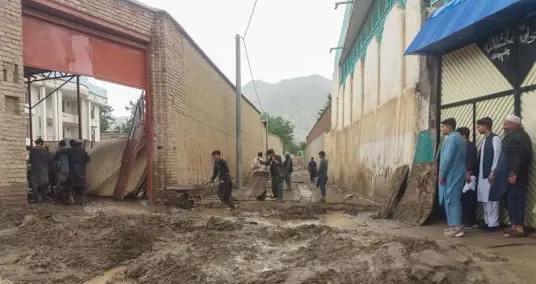
At least 61 people have been killed and 116 injured across Afghanistan since March 26 due to heavy rainfall, floods, landslides and lightning strikes, the Afghan government said on Saturday.
At least four people were still missing after floods affected thousands of families and damaged 2,448 houses, Afghan government spokesman Zabihullah Mujahid said in a post on X.
In addition, thousands of hectares of cropland was also destroyed, posing serious risks to rural communities who rely on agriculture for their livelihoods.
Deadly flooding has struck Afghanistan repeatedly in recent years, causing significant loss of life, injuries and widespread damage to homes, infrastructure and agricultural land.
Extreme weather events such as flash floods and droughts are increasing in Afghanistan, which experts link to the climate crisis.
Despite having a negligible carbon footprint, the country ranks among the most climate-affected nations and remains ill-prepared to cope after decades of conflict, poor infrastructure and a struggling economy, compounded by recent earthquakes and severe flooding.
LATEST POSTS
- 1
 Best Wellness Tracker Keep You On target
 - 2A Russian fighting for Ukraine conned the Kremlin out of $500,000 by faking his own death
- 3Ergonomic Office Seats for Work spaces
- 46 Travel Services for Colorful Get-aways: Pick Your Fantasy Escape
- 5Met Gala 2026 will celebrate fashion as an 'embodied art form': A guide to the theme, dress code, cochairs and hosting committee of the starry event



- Instructions to Pick the Right Toothbrush for Your Teeth
- IDF kills senior PIJ Gaza City Brigade cmdr. who infiltrated Kibbutz Nahal Oz on Oct. 7
- What's inside Mexico's Popocatépetl? Scientists obtain first 3D images of the whole volcano
- Select Your Definitive Pizza Decision
- Partner of crime boss Steven Lyons arrested in Dubai
- Kissing is an ‘evolutionary conundrum.’ Scientists just mapped its unexpected origins
- Vote in favor of the Top Vegetable for Senior
- IDF destroys Hezbollah rocket launcher used in large rocket salvo towards Haifa, Galilee
- Where You Could Sleep With Snorlax in Japan, From MIMARU’s Pokémon Rooms to Grand Hyatt Tokyo’s Limited Pokémon Suite