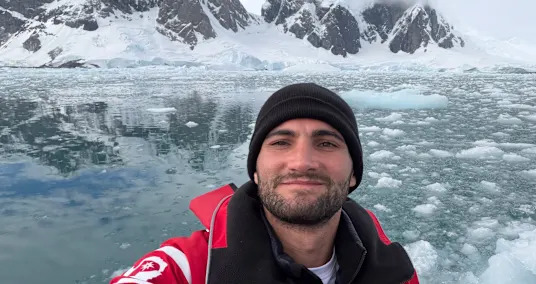
Cameron Mofid visited every country by the time he turned 25.
Last month, a friend invited him to join a trip to Antarctica, the continent he had yet to visit.
The trip showed him that despite visiting all 195 countries, so much of the world remains to be discovered.
In April 2025, I finished a seven-year journey to all 195 countries in the world.
That trip carried me to some of the most remote places on the planet. Yet after thousands of hours on flights and more visa applications than I can count, one major destination was still missing: the elusive seventh continent, Antarctica.
Antarctica hadn't factored into my goal of visiting every country because, technically, it isn't a country.
It was also financially out of reach. Even the most basic trips to the continent often start around $10,000 per person, not including flights.
But when one of my closest friends, a well-known YouTuber, told me he wanted to go, I arranged a collaboration with an expedition company for his channel. This allowed me to tag along.

Heading to my seventh continent
Our journey began in Ushuaia, Argentina, the southernmost city in the world. From there, we boarded our expedition ship, along with around 130 other travelers, and headed toward the Drake Passage, a notoriously rough stretch of ocean known for its relentless storms.
Midway through the crossing, I tried stepping onto the outside deck for a moment of fresh air. Instead, I was hit by 90-mile-an-hour winds that sent me crashing straight back through the door.
After an arduous three days at sea, the water calmed. Glaciers appeared on the horizon and gradually closed in around our ship. That was the moment it became real. We had reached Antarctica.
Antarctica is hard to compare to anywhere else
After traveling through every country in the world, I thought I'd seen every kind of landscape imaginable, but nothing prepared me for the scale of this place. I saw endless white mountains, floating icebergs the size of skyscrapers, and a body of water so vast it seemed to fade into the edge of the world.
On our first full day on the continent, we went kayaking around the glaciers under sunny skies and calm conditions. While paddling, I spotted a dark gray figure in the distance and assumed it was a rock. Then it moved.

What I'd mistaken for stone suddenly became a whale, followed by two more. They swam around our kayaks. In that moment, I felt a deep appreciation for the simple fact that we get to share this planet with creatures like them.
The next morning, the continent showed a completely different side of itself. A powerful blizzard rolled in, turning everything into a blur of white. Despite the weather, we set out in inflatable boats and landed on a small frozen island, snow pelting our faces as we stepped ashore.

That was when we saw a colony of penguins. I looked up and saw more waddling up the hillside, their chicks moving steadily beside them, completely unfazed by the storm. They were perfectly at home in conditions that felt brutal to us, an example of life thriving far from human control.
As the trip went on, I remained mesmerized by the landscapes and wildlife around us. The most profound experience came at the end of the journey, when we had the opportunity to camp on the peninsula. Because we were so far south of the equator, night never fully came.

Even after sunset around 11 p.m., a pale twilight lingered in the sky, enhanced by a glowing full moon.
I barely slept at all, a mix of adrenaline and the harsh conditions kept me awake. Lying there in the middle of the night, surrounded by towering glaciers and mountains, I was reminded of a truth I have learned everywhere I've traveled.
The more of the world you see, the more you understand how much of it remains to be discovered.
Read the original article on Business Insider
LATEST POSTS
- 1
 Toilet rats? Washington health officials warn of possible rodents in sewer systems after floods
 - 2See the moon shine with Saturn in the southern sky after sunset Dec. 26
- 3The most effective method to Promoter for Cellular breakdown in the lungs Mindfulness in Your People group
- 4Doomed SpaceX Starlink satellite photographed from orbit
- 5How Trump's marijuana executive order could change medical research landscape


- From invasive species tracking to water security – what’s lost with federal funding cuts at US Climate Adaptation Science Centers
- Vote in favor of your Number one Kind of Gems
- Watch India launch advanced military satellite on rocket's 1st flight since May 2025 failure
- Robyn returns to music with 'Dopamine,' her 1st single in 7 years: 'Came to save music once again'
- Change Your Skincare: 10 Inventive Magnificence Gadgets
- Passover under fire: Israelis balance fatigue with cautious hope after month of war
- What causes RFK Jr.’s strained and shaky voice? A neurologist explains this little-known disorder
- Instructions to Safeguard Your Speculations In the midst of Changing Disc Rates
- Scientists are getting our robotic explorers ready to help send humans to Mars