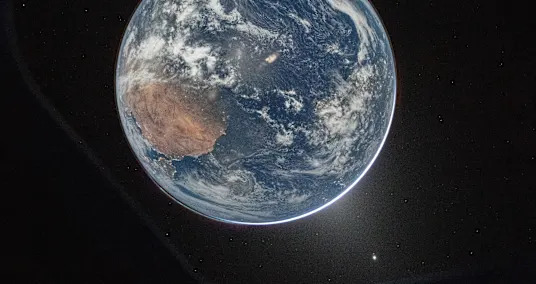
CAPE CANAVERAL, Fla. (AP) — The Artemis II astronauts have captured our blue planet’s brilliant beauty as they zoom ever closer to the moon.
NASA released the crew’s first downlinked images Friday, 1 1/2 days into the first astronaut moonshot in more than half a century.
The first photo taken by commander Reid Wiseman shows a curved slice of Earth in one of the capsule’s windows. The second shows the entire globe with the oceans topped by swirling white tendrils of clouds.
As of midmorning Friday, Wiseman and his crew were 90,000 miles (145,000 kilometers) from Earth and were quickly gaining on the moon with another 168,000 miles (270,000 kilometers) to go. They should reach their destination on Monday.
The three Americans and one Canadian will swing around the moon in their Orion capsule, hang a U-turn and then head straight back home without stopping. They fired Orion's main engine Thursday night that set them on their course.
They're the first lunar travelers since Apollo 17 in 1972.
___
The Associated Press Health and Science Department receives support from the Howard Hughes Medical Institute’s Department of Science Education and the Robert Wood Johnson Foundation. The AP is solely responsible for all content.
LATEST POSTS
- 1
 This Huge Ocean Beast Shifts Sharks’ Evolutionary Timeline
 - 2This ‘CSI: Miami’ star spent years solving crimes on TV. Then she became the target of one herself.
- 3Understanding Various Sorts of Financial balances: An Extensive Outline
- 47 Fast Approaches to Let loose Space on Your Telephone in a flash
- 5From Overpowered to Coordinated: Individual Accounts of Cleaning up




- Why ordering takeout or calling the dog walker might lead to a happier relationship
- NMG signs new graphite supply deal with Canadian Government
- From Modesty to Administration: Self-improvement in Interactive abilities
- Man who grabbed Ariana Grande at 'Wicked: For Good' premiere also rushed Katy Perry onstage this year. Who is he and why is he doing this?
- Moon fever hits DC as Artemis 2 rocket 'candle' lights up Washington Monument just 1 month before launch (photos)
- Story of ‘first Black Briton’ rewritten by advances in ancient DNA technology
- A definitive Frozen yogurt Standoff: Which Flavor Rules?
- Sun storms are powered by a magnetic engine 16 Earths deep, study finds
- First Houthi launch toward Israel since war began triggers alerts across the Negev