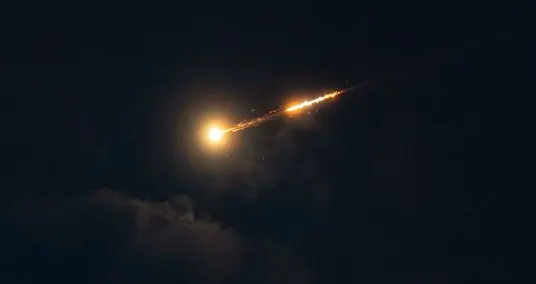
NEW YORK (AP) — The year's first supermoon and meteor shower will sync up in January skies, but the light from one may dim the other.
The Quadrantid meteor shower peaks Friday night into Saturday morning, according to the American Meteor Society. In dark skies during the peak, skygazers typically see around 25 meteors per hour, but this time they'll likely glimpse less than 10 per hour due to light from Saturday's supermoon.
“The biggest enemy of enjoying a meteor shower is the full moon,” said Mike Shanahan, planetarium director at Liberty Science Center in New Jersey.
Meteor showers happen when speedy space rocks collide with Earth’s atmosphere, burning up and leaving fiery tails in their wake — the end of a “shooting star.” A handful of meteors are visible on any given night, but predictable showers appear annually when Earth passes through dense streams of cosmic debris.
Supermoons occur when a full moon is closer to Earth in its orbit. That makes it appear up to 14% bigger and 30% brighter than the faintest moon of the year, according to NASA. That difference can be tough to notice with the naked eye.
Supermoons, like all full moons, are visible in clear skies everywhere that it's night. The Quadrantids, on the other hand, can be seen mainly from the Northern Hemisphere. Both can be glimpsed without any special equipment.
To spot the Quadrantids, venture out in the early evening away from city lights and watch for fireballs before the moon crashes the party, said Jacque Benitez with the Morrison Planetarium at the California Academy of Sciences. Skygazers can also try looking during early dawn hours on Sunday.
Wait for your eyes to get used to the darkness, and don’t look at your phone. The space rocks will look like fast-moving white dots and appear over the whole sky.
Meteor showers are named for the constellation where the fireballs appear to come from. The Quadrantids — space debris from the asteroid 2003 EH1 — are named for a constellation that's no longer recognized.
The next major meteor shower, called the Lyrids, is slotted for April.
Supermoons happen a few times a year and come in groups, taking advantage of the sweet spot in the moon’s elliptical orbit. Saturday night’s event ends a four-month streak that started in October. There won't be another supermoon until the end of 2026.
___
The Associated Press Health and Science Department receives support from the Howard Hughes Medical Institute’s Department of Science Education and the Robert Wood Johnson Foundation. The AP is solely responsible for all content.
LATEST POSTS
- 1
 South Carolina's measles outbreak reaches 434 cases
 - 2Allow Innovative Progressions To have a Massive Effect
- 3Radiated Tortoise Faces Rapid Decline in Madagascar
- 4Two Israeli infants among wounded by shrapnel in overnight Iranian missile barrage
- 5'The Secret Lives of Mormon Wives' Season 3 premieres tomorrow. Here's what you need to know to catch up.



- 10 Delectable Specialty Mixed drinks
- Aurora chaser catches a fox basking in the glow of Finland's legendary 'fox fires' (photos)
- Industrial zone damaged in Negev, falls in Sharon area after Iran fires missiles towards Israel
- Vote In favor of Your Favored Sort Of Dress
- Agios Pharma shares jump as US FDA expands approval for its blood disorder drug
- Step by step instructions to Show Children the Significance of Appropriate Handshaking
- Ocean side Objections: Staggering Waterfront Breaks
- The newest 'Project Hail Mary' trailer shows Ryan Gosling befriending an alien in Phil Lord and Chris Miller's space epic
- Kansas school officials report high student illness, dismiss early