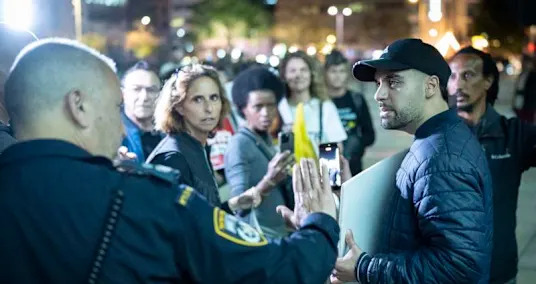
Protests took place in Tel Aviv, Jerusalem, Haifa, and Beersheba, as a survey found broad but uneven support among Jewish Israelis for Operation Roaring Lion.
Israel Police arrested 21 anti-war protesters Saturday night as demonstrations against the conflict with Iran expanded in multiple cities despite restrictions on public gatherings.
Protests took place in Tel Aviv, Jerusalem, Haifa, and Beersheba, with hundreds of participants reported in Tel Aviv and Jerusalem and about 100 in Haifa, marking the largest turnout since weekly demonstrations began. Authorities said 13 people were arrested in Tel Aviv and eight in Haifa.
Police said the gatherings were not approved under Home Front Command regulations that ban events with more than 50 people. Officials said the increase in turnout followed calls by groups opposing the government to protest despite the restrictions.
“During a situation assessment that took place at the scene with a Home Front Command representative… it was clarified that there was a real risk to human life and accordingly, Yarkon [precinct] police commander Tzachi Sharabi ordered the gathering to be dispersed,” police said.
Hadash-Ta’al chairman Ayman Odeh, an Arab lawmaker involved in the protests, criticized the police response, calling officers fascists “in the service of the government” and saying they were afraid of “the heroic citizens who went out, despite everything, to make their voice heard.”

Survey shows broad, uneven support for war
The demonstrations come as a March 2026 survey by the Israel Democracy Institute found broad but uneven support among Jewish Israelis for Operation Roaring Lion. Support was strongest on the Right at 87% and about half on the Left.
The survey also found that Jewish and Arab respondents largely agreed that Iran’s resilience has been stronger than expected. Most Jewish respondents said Israeli society could sustain the campaign for up to one month, while 28% said as long as needed. Arab respondents were less optimistic about how long the public could endure the conflict.
A majority of Jewish respondents said Prime Minister Benjamin Netanyahu’s decision was driven by security considerations, while most Arab respondents viewed it as political.
LATEST POSTS
- 1
 Zelensky confidant dismissed from further posts amid bribery scandal
 - 2Most loved Seared Chicken: Which Chain Rules?
- 3Iranian missile hit on Ne'ot Hovav factory leads to fear of chemical leakage
- 4South Korea president says Iran war shows the need to ditch ‘extremely risky’ fossil fuels
- 5How a seabird native to Hawaii has adapted to life in Honolulu's concrete jungle




- From Educational Loans to Obligation Free: Independence from the rat race Accomplished
- The most effective method to Oversee Unsold SUVs in the Car Business
- Kobe Bryant called this WNBA star the 'Gold Mamba.' She turned his advice to her into a tattoo.
- Bolsonaro briefly leaves Brazilian prison for medical tests after a fall from his bed
- Good ways to respond if your kid brings home less-than-ideal grades
- 2026 Golden Globes: How to watch, start time, TV channel, full nominee list and more
- Understanding Successful Compromise Standards to Cultivate Agreeable Connections
- A coup too far: Why Benin's rebel soldiers failed where others in the region succeeded
- Fossils unearthed in Morocco are first from little-understood period of human evolution